
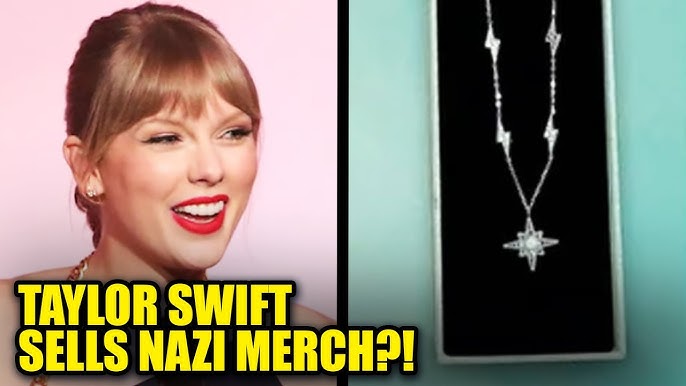
A report by FASCISMWATCH with the help of A.I.
This report serves as a critical, evidence-based follow-up to the FascismWatch article, "Critique: Taylor Swift, the ''Centrist'' Icon Who Disarms Resistance and CBC loving it..." [23]. That original piece established the thesis that Taylor Swift's calculated political positioning—a "centrism" that structurally supports the far-right [23]—is a commercially expedient façade. This current analysis demonstrates that this façade has collapsed entirely, drastically escalated by recent controversies surrounding her merchandise and lyrics. The initial critique highlighted her brand's complicity through association with sponsors like the "Zionist" bank Capital One (a creditor to Elbit Systems Ltd, an Israeli weapons manufacturer, via a $500 million loan [2]). Now, she faces direct and concrete accusations of propagating coded racial messages and co-opting white supremacist aesthetics, meticulously detailed in the October 2025 YouTube video titled "Taylor Swift Accused of Selling Nazi-Inspired Merch, Writing Racist Lyrics" [16] from the program Indisputable with Dr. Rashad Richey. These actions reveal that her status as a 'centrist icon' is a manufactured political neutrality designed purely to maximize profit. Furthermore, the inclusion of an alleged musical homage to Elizabeth Taylor, whose history as an ardent, lifelong Zionist activist, adds another significant brick to the wall of evidence dismantling Swift's claim to political neutrality. Her calculated rise is a cultural phenomenon that demands political scrutiny, serving as a paradigm case study in how celebrity neutrality is weaponized for profit.
The video report from Indisputable with Dr. Rashad Richey
New Controversies Fueling the Critique: The Move Towards White Supremacy
The new album, The Life of a Show Girl [1], released in October 2025, and its associated merchandise have brought the singer's political neutrality into sharp focus, exposing what critics call a lack of essential diversity and perspective within her organization [16] that enables the use of deeply offensive symbolism.
Nazi-Inspired Merchandise: The Life of a Showgirl Silver Necklace: Taylor Swift was accused of selling a Nazi-inspired necklace from her official online store [16]. The item, titled the "Life of a Showgirl Silver Necklace" [16], immediately drew condemnation. The design featured distinct lightning bolt links and an eight-point star [16]. Critics immediately pointed out that this style of lightning bolt is heavily associated with white supremacy and Nazism, specifically recalling the SS symbol when paired and presented in a stylized manner [29]. The Schutzstaffel (SS), the paramilitary organization of the Nazi Party, utilized a distinctive 'Sig rune' in their insignia, which is visually represented by two stylized lightning bolts [29]. The design of the jewelry, whether intentional or not, directly invokes this infamous, globally recognized symbol of fascism and the Holocaust [29]. The product was subsequently and swiftly removed from her website [16], but not before the entire stock had fully sold out [16], indicating a substantial audience that may be either intentionally or unknowingly consuming fascist aesthetics. The fact that the entire stock of the "Life of a Showgirl Silver Necklace" sold out in less than 24 hours following its unveiling in October 2025 is a chilling commercial metric [16], underscoring the reach of her brand into potentially radicalized segments of the market. Neither Swift nor her team has issued a public statement on its removal or on the design's origins [16], which critics view as a tacit admission of guilt and a calculated attempt to let the controversy die down without accountability [16]. The silence on such a politically charged item further validates the argument that her brand prioritizes market viability over moral clarity. The episode highlights a complete organizational failure in basic historical and political due diligence, a negligence critics argue is only possible if white-centric, far-right coded messages are an accepted (or at least tolerated) part of the brand's aesthetic language. The deliberate and total silence following the item's swift removal is viewed as a corporate strategy of "de-escalation through erasure", which profits from controversy without incurring political cost.
Racialized Lyrics in "Opalite": Coded Language and Exclusion: Further scrutiny focused on the lyrics of the song "Opalite," which critics accuse of containing racially insensitive references to Kayla Nicole, the Black ex-girlfriend of Swift’s current partner, Travis Kelce [16]. The song uses the stark contrast between "sleepless Onyx nights" and the reward of "opalite skies" [16]. This juxtaposition is interpreted by cultural critics as a pointed racialized code—where the "milky white" and iridescent opalite, a stone often associated with purity and lightness, symbolizes Swift and the desired end of Kelce's "dark" past relationships, which were primarily with Black women [16]. This lyrical choice not only serves to elevate the singer's own whiteness as the ultimate reward but actively frames the partner’s past life—and the women of color in it—as the "Onyx" darkness that must be overcome for redemption [16]. The choice of "Opalite" and "Onyx" is not merely stylistic; it exploits a centuries-old literary trope where white is equated with purity and dark with danger or impurity [30]. This narrative is argued to constitute a form of microaggression and dog whistle [16] that normalizes a white-centric narrative of traditional male dependency and redemption while reinforcing the systemic exclusion of women of color from her partner’s public life history [16]. The subtlety of the language makes the critique difficult to dismiss as simple 'hatred' while still operating as a deeply embedded form of racial bias, all while leveraging the narrative for commercial gain. Critics have noted the pattern of erasure of Black women from narratives involving powerful white celebrities, with this lyric acting as a particularly callous commercialization of that erasure [30].
Pattern of Racial Rhetoric: Explicit and Implicit Bias: Two other elements from the new album and past comments solidify this emerging pattern of racial bias. The lyric from a song on the album, "All my white diamonds and lovers are forever," drew immediate criticism for its unnecessary, conspicuous emphasis on "white" when referring to both diamonds and romantic partners. This phrasing is interpreted by critics as an explicit and revealing instance of racial rhetoric [16] that centers whiteness as the ultimate signifier of permanence, value, and emotional stability within her world-view, an assertion that is wholly unnecessary unless the deliberate centering of race is the underlying intent [16]. Separately, critics highlighted a previous, unconfirmed comment where Swift allegedly compared the mixed Asian woman, Charlie XCX, to a Chihuahua [16], an analogy viewed as a dog whistle that perpetuates harmful stereotypes against the continent of Asia and its people [16]. The pervasive and varied nature of this racial subtext—ranging from coded lyrics and direct racial descriptors to uncritical adoption of white supremacist symbols—demonstrates a consistent organizational failure of due diligence and a profound blindness to the political ramifications of her aesthetic and lyrical choices. The consistent pattern suggests that this is not an accident but a reflection of a deep-seated lack of political and racial awareness within the highest echelons of her multi-billion dollar corporation.
Past elements in Swift history
Midnights Album Cover Imagery: An Inadvertent Swastika and Occult Aesthetics: Adding a layer of critique concerning political symbolism and esoteric imagery, critics have highlighted the visual presentation of Swift's earlier album, Midnights (released October 21, 2022). When the four different Midnights vinyl covers were carefully placed together to display the full clock face design, the collective arrangement of the individual album covers was noted for inadvertently forming a swastika-like shape [37]. This visual coincidence further draws accusations of poor judgment, carelessness, or a concerning organizational willingness to flirt with sensitive political symbols. Beyond the political symbolism, the entire aesthetic of the Midnights album, with its clock imagery and use of a specific style of occult typography, has been linked to the broader trend of normalizing esoteric and potentially problematic sub-cultural aesthetics within mainstream pop [32]. This normalization, critics argue, is part of the overall structural complicity where aesthetic edge is sought without any acknowledgment of the symbols' historical or political weight, which directly overlaps with the critique regarding the Nazi-inspired jewelry.
Precedent: A Prefiguring of Negligence – The 2009 Swastika Controversy (October 2009) The organizational pattern of proximity to, and defensiveness regarding, symbols of hate is not new but rather prefigured by a high-profile incident from October 2009. A photograph circulated widely, showing the then 19-year-old artist posing at Katy Perry's 25th birthday party in West Hollywood with a male guest who had a large swastika painted on his shirt [43]. This event, documented extensively in the media [44], served as an early warning of the public scrutiny Swift would face concerning associations with hate symbols. The guest was identified as model AJ English [43], who apologized and claimed the symbol was an altered "X" and not intentional, explicitly denying support for the Nazi agenda [43]. Despite Swift's representative stating that the singer was unaware of the symbol and did not know English [43], the necessity of this corporate defense mechanism—a deflection to "unawareness"—was established years before the 2025 controversies involving the SS-like jewelry and racialized lyrics. The 2009 incident, viewed in the context of the later use of such imagery, suggests a long-standing, structural failure to exercise due diligence or political awareness, where symbols of genocide have repeatedly entered Swift's public sphere.
Corporate Defense Against Political Critique: The Legal Attempt to Suppress White Supremacy Link (2017) Taylor Swift's long-standing strategy of political silence, which critics argue permitted the long-term co-option of her image by the far-right, was eventually replaced by aggressive legal action when the criticism became explicit. In 2017, following years of tacit acceptance of her "Aryan Goddess" status among neo-Nazis, Swift's legal team issued a letter threatening a lawsuit against the independent blog, PopFront [45]. The letter targeted an article titled "Swiftly to the Right: How Taylor Swift is an Icon of White Supremacy" which linked her aesthetic and political inaction to her status as a figurehead for neo-Nazis and white supremacists [45]. Swift's lawyer claimed the piece was defamatory and libelous and demanded its retraction [46]. This legal threat was immediately challenged by the ACLU (American Civil Liberties Union), which publicly defended the blogger, Meghan Herning, arguing that the article was protected political speech and commentary [45]. The ACLU characterized the legal action as a Strategic Lawsuit Against Public Participation (SLAPP), an attempt by a wealthy, powerful figure to intimidate and suppress political criticism [46]. This legal maneuver to control the public conversation around her political image occurred years before the 2025 controversies involving the SS-like merchandise and racialized lyrics, establishing a clear corporate defense mechanism against explicit critiques that link her brand to the far-right.
Historical Context of the White Supremacist Affinity: The 'Aryan Goddess' Critique
The controversies of 2025 involving the Nazi-inspired necklace and coded racist lyrics are not isolated organizational failures but the culmination of a decade-long embrace of Taylor Swift's image by the white supremacist movement. Since as early as 2016, critics have been flagging Swift's passive political neutrality and manufactured aesthetic for their dangerous appeal to the far-right. The 2016 NPR Code Switch article titled "Taylor Swift, 'Aryan Goddess'" [28] provided a seminal analysis of how white supremacists online had already fully co-opted her image. The article documents how prominent neo-Nazi forums and white nationalist commentators explicitly claimed Swift as an ideological icon, frequently referring to her as an "Aryan Goddess" or "Aryan Princess" [28].
This disturbing trend centered on Swift's carefully curated aesthetic—specifically her whiteness, blond hair, blue eyes, and her image as a pristine, idealized figure of traditional European femininity [28]. These characteristics were celebrated by the far-right as the very embodiment of the Aryan ideal they seek to propagate. White supremacist figures, such as those writing for The Daily Stormer, used her as a figurehead to recruit young, white, impressionable women into their ideology, claiming that the singer was "secretly a Nazi" and was giving a "call to action" for white revolution through her implicit whiteness [28]. The far-right's persistent co-option of her image demonstrates that for a significant, if fringe, political audience, her brand is already operating as a political dog whistle for the glorification of white, traditional, European identity [33].
Crucially, this 2016 critique highlighted the profound ethical failure of Swift and her team: the failure to respond. As the NPR article pointed out, despite the high-profile, public embrace by groups actively promoting hate speech and violence, Taylor Swift maintained complete silence [28]. Her refusal to forcefully repudiate the endorsement of these organizations was interpreted by critics not as a sign of 'apolitical centrism', but as a calculated decision to avoid alienating a lucrative, radicalized segment of her audience [28]. This strategic silence allowed her brand to exist in a politically convenient ambiguity, implicitly sanctioning the reading of her image as an icon of white purity. The failure to address the matter in 2016 left a significant political vulnerability, which manifested in the commercial production of SS-like imagery almost a decade later. This corporate negligence or calculated indifference fundamentally compromises her claim to political neutrality and lends credence to the idea that her organizational blind spots are, in fact, politically expedient choices. The move from an "Aryan Goddess" figurehead to selling explicitly Nazi-style merchandise represents a chilling commercial progression rather than a sudden, unpredictable misstep. The core issue remains that Swift has consistently prioritized commercial safety over moral clarity when confronted with white supremacy's embrace.
The Structural Appeal to the Far-Right: Commercializing White Female Victimhood
Beyond the aesthetic 'Aryan Goddess' co-option, Taylor Swift's brand narrative structurally aligns with far-right rhetoric through its constant emphasis on white female victimhood. The far-right sphere, which is deeply rooted in anti-feminist and traditionalist movements, often weaponizes the narrative of the 'plight of the white woman' as a key recruitment tool and a rallying cry against what they perceive as the moral decay of modern society [39]. Swift's entire artistic output is often centered on the theme of betrayal, being wronged by an individual (often male), and her subsequent righteous quest for justice or vindication. This narrative is commercially successful because it is universally relatable but politically potent because it provides a familiar, sanitized framework for grievance politics.
The far-right leverages this trope, viewing the virtuous, wronged white woman as the purest embodiment of the "traditional" Western identity that they claim is under attack by modernity, multiculturalism, and feminism itself [39]. Swift's carefully curated image of purity and vulnerability, which precedes her vengeful responses, makes her the perfect cultural conduit for this political narrative. Her brand appeals to a white demographic that feels culturally displaced or victimized by perceived social changes, mirroring the conservative grievance against cultural elites and a shift away from traditional structures. While Swift may not be intentionally peddling this message, the commercial structure of her music—which elevates personal betrayal into a public spectacle of righteousness—is perfectly suited to be co-opted and utilized within the far-right's broader strategy of framing the dominant culture (whiteness, tradition) as the true victim of contemporary politics. This structural alignment allows her brand to maintain its enormous, white-centric market share while implicitly, and thus safely, validating the emotional core of far-right grievance.
The Repulsive Façade: Taylor Swift's 2019 Condemnation of White Supremacy
This historical silence and structural complicity stand in stark contradiction to a highly public statement made in September 2019, which now, in the context of the 2025 controversies, exposes a profound corporate hypocrisy. During the promotional cycle for her album Lover, and in the wake of years of sustained criticism for her political non-engagement, Taylor Swift finally broke her silence on the far-right, explicitly denouncing white supremacy in a major interview with The Guardian [38]. She emphatically called white supremacy "repulsive" and justified her public shift toward the Democratic party as a necessary stand against the hateful rhetoric of the time [38]. She stated, "I needed to clearly state that political leaning, because I feel like, there are certain things that are so sad and terrifying and horrific... and I can't look the other way" [38].
This 2019 commitment to political clarity and moral opposition to white supremacy—her promise not to "look the other way"—provides the starkest possible contrast to her current actions in October 2025. The commercialization and sale of the "Life of a Showgirl Silver Necklace" with its distinct SS-like lightning bolt links (a globally recognized symbol of the very "repulsive" ideology she once claimed to fight) and the use of the racially coded "Opalite" lyrics are not merely 'careless mistakes'; they are, in this new context, a profound act of corporate hypocrisy. Her 2019 words now serve as an institutional shield, designed to ward off criticism while her 2025 products are seen as commercially catering to the very aesthetic and ideological fringes she once vowed to reject. This trajectory suggests that her initial political awakening was less about genuine moral conviction and more about establishing a necessary, marketable defense against the persistent 'Aryan Goddess' critique, a defense she has now completely dismantled for profit by selling the very symbols she once repudiated.
The Political Homage: Elizabeth Taylor and the Normalization of Zionism
The album, The Life of a Show Girl, contains a track widely interpreted as a direct tribute to the late Hollywood icon Elizabeth Taylor [18]. This choice of subject further chips away at Swift’s neutral persona, as Elizabeth Taylor was not merely a celebrity who supported Israel, but one of the most visible, influential, and ardent Zionist activists in Hollywood history. By implicitly aligning herself and her current album’s themes with this figure, Taylor Swift's 'centrist' stance is severely compromised, exposing an association with an uncompromising, politically charged position that directly undermines any claim of even-handedness or political neutrality in complex global conflicts.
Elizabeth Taylor's Deep Commitment to Zionism
Elizabeth Taylor's connection to Zionism was profound, consistent, and active, dating back to her conversion to Judaism in 1959 [18]. Her commitment manifested in specific, highly public, and politically significant actions throughout her life, which critics argue Swift must be aware of when choosing her as an inspiration:
Confronting Arab Boycotts: In 1962, Taylor's landmark film Cleopatra was officially banned in Egypt after she converted to Judaism and publicly declared her fervent support for Israel [18]. She deliberately defied the ban and adamantly refused to back down from her political stance, famously telling an Israeli newspaper in 1965, "I am a Jew and proud of it. I intend to bring up my children in the Jewish faith" [19]. This was a clear, high-stakes trade-off of market access for political expression, a sharp contrast to Swift's later market-first approach. This act of public defiance was highly instrumental in shaping the perception of Hollywood's relationship with Israel.
Political Advocacy and Direct Fundraising: Throughout the 1970s, her personal involvement with Israeli causes escalated to direct political action and mobilization. In 1975, she was among the prominent public figures who signed a deeply critical letter demanding the resignation of then-French President Giscard d'Estaing over his perceived anti-Israel policies [18]. In 1975, Taylor did more than sign a letter; she openly challenged the diplomatic policy of a major NATO ally, France, demanding the resignation of then-President Valéry Giscard d'Estaing [18]. Her activism extended to continuous, visible fundraising efforts, where she lent her enormous global star power to organizations supporting the state of Israel [20]. Her consistent actions established a celebrity precedent for politically active, vocal Zionism.
Defying Terrorist Threats and Political Pressure: Taylor's advocacy was notably undeterred by direct threats and global political pressure. Following the tumultuous 1976 hijacking of an Air France plane and the ensuing Entebbe raid, Taylor made a dramatic and high-stakes political gesture: she publicly offered herself as a hostage in exchange for the 106 mostly Israeli and Jewish captives and signed a highly publicized petition urging the US government to block an arms sale to Egypt and Jordan [18]. These actions were not mere celebrity endorsements; they were direct, high-stakes political statements that confirmed her status as an active participant in the global political sphere on behalf of Israel. The 1976 incident during the Entebbe raid saw her offering herself as a hostage for the captives, an act of dramatic, high-stakes political solidarity that few celebrities would risk today.
Undermining Diplomatic Relations: In a move that highlights the depth and political impact of her commitment, Taylor helped organize a major event protesting the sale of French Mirage jets to Arab states, a political maneuver that infuriated the French government and impacted international diplomatic relations at a critical, sensitive time in the Middle East [18].
By releasing a track that invokes Elizabeth Taylor, Taylor Swift chooses to honor a figure whose entire later-life legacy is inextricably linked to active, high-profile Zionist political warfare and the normalization of Israel on the world stage [18], often at the direct expense of any consideration for Palestinian rights or Arab state relations. This deliberate cultural alignment—a conscious decision to celebrate an icon of vocal Zionism—is not politically neutral; it is an endorsement of a staunchly political, pro-Zionist legacy, further complicating Swift's already tenuous attempt to maintain a 'centrist icon' façade. The calculated absence of a public statement addressing this political baggage, while releasing the track for maximum commercial effect, reveals a strategy to profit from the implicit political endorsement without facing the direct accountability that comes with an explicit political alignment. This is the core of her 'centrism'—a highly profitable, risk-minimized, right-leaning complicity. The homage serves as another piece of material evidence that her brand is fundamentally non-neutral.
Institutional Normalization Amidst a Shifting German Context
Almost simultaneously with the backlash over the Nazi-inspired necklace controversy in October 2025, a German museum made an astonishing, highly visible association with Swift, highlighting the institutional willingness to normalize her brand despite the dark symbolism and political baggage.
The Hessische Landesmuseum in Wiesbaden, Germany saw an unexpected flood of Swift fans flocking to see the Art Nouveau painting Ophelia by Friedrich Heyser (circa 1900) [17, 12], simply because it closely resembled the opening scene of Swift's new music video, "The Fate of Ophelia." The museum director, Andreas Henning, expressed public delight at the unexpected attention and increased ticket sales [17]. This overt, uncritical institutional embrace in Germany—a country where sensitivity to Nazi imagery is correctly paramount due to historical necessity—at the very moment Swift was being heavily accused of leveraging SS-like imagery and coded racism, and celebrating a staunch Zionist icon, demonstrates a profound and alarming global institutional normalization of her brand. This cultural acceptance is politically significant.
Contextualizing Contemporary Germany: ICJ and the Far-Right Surge
This institutional embrace must be viewed within the fraught contemporary political context of Germany, which is currently undergoing a significant shift that brings its national identity—rooted in post-Holocaust commitments—into question.
Support for Israel and ICJ Accusations: Germany has positioned itself as one of Israel's staunchest global supporters following the October 7, 2023 attacks by Hamas [10]. In a decision deeply rooted in its national history and the crimes of the Shoah [10], Germany's government has affirmed that Israel's security is its absolute priority, calling it a "perpetual task" [14]. This historically-driven political stance led Germany to take the extraordinary step of intervening on Israel's behalf at the International Court of Justice (ICJ) in January 2024 against a case brought by South Africa alleging that Israel was committing genocide in Gaza [10, 11, 13]. The German government issued an aggressive statement, emphasizing it "decisively and expressly reject[ed] the accusation of genocide" and intervened to help "refute this despicable lie" [10, 11, 13]. Subsequently, in March 2024, Nicaragua brought a separate, highly critical case against Germany before the ICJ, alleging that by providing political and military support, including arms sales, Germany was "contributing to the commission of genocide" and other serious international law violations against Palestinians [13, 15, 24]. Germany has rejected these claims as "grossly biased" and "lacking jurisdiction" [9, 13]. The broader political significance of a German institution embracing an artist accused of using coded Nazi imagery and celebrating a staunch Zionist icon, while the German government faces accusations of complicity in genocide based on its post-Holocaust-rooted policies, underscores a profound and perhaps cynical institutional normalization of any brand that can distract from or neutralize severe political critique. The use of a popular, seemingly apolitical figure serves as a cultural lubricant for these deeply contested state actions.
The Albanese Critique on German Complicity: This institutional defense of Israel at the ICJ is directly challenged by UN Special Rapporteur on the Occupied Palestinian Territories, Francesca Albanese. In March 2024, Albanese presented her authoritative report, Anatomy of a Genocide, which concluded there were "reasonable grounds to believe" that Israel was committing genocide in Gaza [3, 4, 15]. Her work directly indicts the political and military support offered by Western nations. She explicitly stated that France and Germany had both accused her of "hate speech and antisemitism" at the UN for her focus on Israel's alleged genocide [3]. Furthermore, Albanese has described the support of key Western governments, notably the United States and Germany, for Israel’s actions in Gaza as a "shameful diplomatic and military support" and "political collusion and military complicity" in the "annihilation of Gaza" [5]. Critics who align with Albanese's perspective argue that Germany's current political position—rooted in an overwhelming sense of historical guilt regarding the Shoah—is now cynically weaponized to enable contemporary atrocities, creating a perverse historical echo where a commitment to fight one genocide is used to enable another. Albanese's explicit naming of Germany's active opposition to her findings, which aligns with the ICJ's initial ruling that South Africa's genocide claim was "plausible" [3], heightens the scrutiny of the German museum's uncritical endorsement of an artist flirting with fascist aesthetics. The political spectrum thus exposes the uncomfortable truth that far from being a purely "centrist" decision, the German government’s foreign policy is highly contested by key international human rights figures for its complicity in alleged genocide.
The Rise of the Far-Right AfD and the "Un-German" Critique: Furthermore, the domestic political landscape in Germany has been dramatically altered by the surge of the far-right populist party, Alternative for Germany (AfD). Accused by critics of being a "racist and antisemitic party" that exhibits clear neo-Nazi tendencies and actively trivializes Holocaust history, the AfD has seen its popularity skyrocket in recent years [6, 7]. In the February 2025 federal elections, the AfD doubled its vote share from 10.4% in 2021 to 20.8%, making it the second-largest party in the Bundestag [8]. The party has capitalized on widespread discontent over immigration, economic concerns, and a general anti-establishment rhetoric, performing particularly well in the former East Germany [8, 7]. The rise of a party frequently labeled as exhibiting neo-Nazi characteristics, combined with a cultural institution's uncritical promotion of a celebrity who sells SS-like symbolism, presents a deeply unsettling picture of the contemporary German zeitgeist. This makes the Museum Wiesbaden's delight not merely a cultural oddity, but a symptom of a much larger, darker political and institutional trend toward normalization and distraction from systemic issues. The German political establishment's reaction to the AfD has been increasingly vocal, with prominent figures labeling the party and its leaders as "un-German" or a threat to democratic order, yet the party's commercial and political appeal continues to surge [34]. This internal struggle for the soul of German post-war identity provides the final, critical context for the institutional embrace of Swift: in a moment of acute political instability, her brand of cultural escapism is seen as a necessary, financially rewarding distraction from the country's profound ideological and political fracturing.
The report on the German museum's association was originally carried by the Associated Press (AP) [17], an agency with a documented and often-criticized history of cooperating with the Nazi regime between 1933 and 1945 to maintain access [21, 22].
The Foundations of Complicity: German Roots and Scandal-Ridden Finance
The structural critique of Taylor Swift's brand is incomplete without examining the financial and ethnic roots of the wealth that launched her career. Her family’s professional background is deeply embedded in the upper echelons of the American financial sector—a sector repeatedly accused of operating with the exact kind of neoliberal impunity that critics argue structurally aligns with far-right objectives. Furthermore, her family's background, including documented German ancestry, adds a layer of historically charged complexity to the ongoing 'Aryan Goddess' critique, particularly when placed alongside the uncritical endorsement from a German cultural institution.
German Ancestry and the 'Aryan' Co-option
While Taylor Swift's immediate family comes from an established American background, she has documented German ancestry [41], a fact that provides a deeper context to the 2016 critique that co-opted her as an "Aryan Goddess" [28]. The German cultural and ethnic lineage, combined with her quintessential 'white American' aesthetic of blond hair and blue eyes, creates a perfect, historically loaded canvas for neo-Nazis and white supremacists to project their ideal of European purity [33]. This subtle, non-disclosed ethnic root, when linked to the recent German museum endorsement [17] and the resurgence of the far-right AfD [8], suggests her image operates on multiple historical and ethnic levels as a symbol of re-centered European-American identity, a phenomenon central to the far-right's cultural project.
The Merrill Lynch Money: Structural Alignment with Far-Right Objectives
The financial stability and resources that allowed Scott Swift to facilitate his daughter’s career were derived from a decades-long career as a stockbroker-turned-vice-
Merrill Lynch’s timeline of controversies demonstrates a consistent pattern of prioritizing predatory financial practices and shielding corporate executives from accountability, issues that resonate deeply with right-wing, ultra-capitalist ideology:
Selling Risky Investments and Public Harm (1998): In 1998, Merrill Lynch paid $400 million to settle claims that it sold inappropriate and risky investments to Orange County, California [42]. This action directly caused a massive public financial catastrophe, leading to the county's bankruptcy. This demonstrates a core tenet of the far-right economic philosophy: the willingness to inflict widespread public economic damage in pursuit of massive private profit, with the expectation that the firm will only face a manageable financial penalty [43].
Misleading the Public and Financial Impunity (2002): The firm paid $100 million in 2002 to settle charges of publishing misleading analyst research during the dot-com bubble [42]. This manipulation of information for private gain is structurally consistent with the far-right's skepticism of truth and its prioritization of corporate success over market integrity, illustrating the systemic deceit built into the financial system that funded the Swift family's move to Nashville [43].
Corporate Criminality and Elite Accountability (2004): Several Merrill Lynch executives were convicted in 2004 for their role in helping Enron hide debt [42]. The firm’s direct complicity in one of the most infamous corporate fraud cases in American history proves its institutional willingness to engage in high-level criminality to maintain the appearance of financial stability. This culture of executive impunity is a mirror of the power structures that the far-right seeks to maintain and protect: the powerful operating above the law [43].
Institutional Discrimination (2007): In 2007, the U.S. Equal Employment Opportunity Commission (EEOC) filed a lawsuit alleging widespread discrimination within the firm [42]. This charge highlights the institutional bias—sexism and racism—embedded within the corporate environment that generated the Swift family's wealth, further linking the financial system to the issues of white-centric power structures and the exclusion of minorities that the anti-Swift critique focuses on [30].
Regulatory Failures and Minimal Penalties (2009–2019): Between 2009 and 2019, the firm failed to file hundreds of suspicious activity reports (SARs), resulting in a minimal $6 million fine from the SEC [42]. The fine, a pittance compared to the firm's overall revenue, underscores the regulatory system's failure to impose meaningful consequences, which itself acts as a tacit approval for continued high-risk, low-transparency operations. This structural leniency is fundamentally aligned with the far-right's anti-regulation agenda [43].
Contemporary Corporate Raiding (2025): The recent high-profile lawsuit in 2025 over an alleged "corporate raid" to poach clients and advisors [42] demonstrates that the culture of aggressive, zero-sum, internecine competition and unethical business maneuvering persists within the firm.
Scott Swift’s position as a Vice President and the owner of a long-running, successful advisory group within this historically and ethically compromised corporate structure means that his daughter's career was not simply funded by 'finance,' but by a system repeatedly proven to operate with structural impunity and a clear disregard for legal and ethical standards when they impede profit. This foundation in an institution that embodies right-wing, ultra-capitalist objectives directly underpins the political neutrality of his daughter’s brand—a brand that seeks maximum profitability within this same unchecked system.
The Political Contradiction: Taylor Swift's Endorsement of Kamala Harris—The 'Blue MAGA' Icon
The final piece of evidence shattering Taylor Swift's claim to political neutrality is her high-profile support for US Vice President Kamala Harris [26, 27]. This endorsement moves Swift from a position of commercial-driven complicity to one of active political alliance with a figure critics widely characterize as "Blue MAGA"—a term used to describe establishment Democrats who leverage identity politics and progressive rhetoric to mask fundamentally conservative, militaristic, and carceral policies. Swift’s public alignment confirms her political compass points squarely toward the lucrative, militarized center-right establishment.
Kamala Harris: The Financially-Driven Zionist Ally and Neoliberal Architecture
The most potent critique of Harris's centrist façade lies in her unwavering and unconditional support for Israel, a position that undermines any claim to a truly progressive, humanitarian, or non-aligned stance [25].
Financial and Political Entrenchment: Critics point out that Harris has received over $5 million from the Zionist lobby [25], demonstrating that her political alignment is heavily funded and institutionally mandated. She has consistently positioned herself as "openly a zionist," actively supporting Israel's actions and policies [25]. This financial and ideological commitment is seen as a direct refutation of any claim to centrist or progressive foreign policy.
Unconditional Military Support: At an AIPAC conference, Harris explicitly pledged unconditional military support for Israel [25]. Her dedication to this position is so absolute that she has refused to pledge to enact an arms embargo on Israel, even as global scrutiny intensifies over the military conduct in Gaza [25]. Her AIPAC conference appearance saw her deliver a highly aggressive pledge of military support, stating her commitment to Israel was "ironclad and enduring," a message critics argue is indistinguishable from the far-right rhetoric of figures like Donald Trump. This hardline, pro-military, pro-expansionist foreign policy is a direct rejection of centrist neutrality and firmly aligns her with the right-wing of the political spectrum on a core global issue, structurally mirroring the unconditional support seen in the MAGA movement.
The Black Woman/Zionist Paradox: Harris's support for Israel, despite being a Black woman, is viewed by critics as the ultimate betrayal of progressive ideals and an abandonment of global anti-colonial movements. This dynamic is particularly significant because the far-right, the MAGA movement, and white supremacy are widely associated with the unconditional support of Israel through the political alliance between leaders like Benjamin Netanyahu and Donald Trump. By adopting this same unconditional stance—which critics argue sustains a system of apartheid and military occupation—Harris structurally aligns herself with the same right-wing, white-supremacist apparatus that Swift superficially opposes. Swift’s endorsement, therefore, is an endorsement of this right-aligned political machine.
Neoliberal Alignment: Beyond her foreign policy, Harris is criticized as a definitive product of the neoliberal political architecture that governs the contemporary Democratic Party [35]. This critique focuses on her consistent support for policies that prioritize corporate interests and maintained stability, which is essential for a billionaire brand like Swift. Harris's brand of progressivism is seen as primarily cosmetic—using identity markers (race, gender) to mask a fundamental adherence to the military-industrial complex and the maintenance of the carceral state [35]. This is the very definition of the Blue MAGA project: a system that leverages social justice language to maintain an economically and militarily conservative status quo, making her the ideal political counterpart to Swift’s culturally centrist commercial brand.
The Progressive Cop Myth: Kamala Harris's Law-and-Order Record
The critique of Kamala Harris as a true progressive is further complicated by an extensive look into her legal record as both San Francisco District Attorney (2004-2011) and California Attorney General (2011-2017). The central thesis, articulated by critics since January 2019 [40], is that she carefully crafted an image of a "Progressive Prosecutor" while consistently pursuing policies that were conservative, pro-law enforcement, and detrimental to genuine criminal justice reform.
"Tough-on-Crime" Policies and Truancy: During her tenure, Harris earned a reputation for being "tough-on-crime," a stance traditionally associated with the Republican party and the conservative backlash against criminal justice reform. Most famously, she championed and rigorously enforced truancy laws that allowed her office to prosecute and threaten the parents of chronically truant children with jail time, a policy criticized as disproportionately impacting poor and minority families and treating a social issue as a criminal one [40].
Opposition to Reform and Police Accountability: Contrary to her later political branding, she consistently resisted major statewide criminal justice reforms. She opposed Proposition 47 in 2014, a ballot initiative that reclassified certain non-violent felonies as misdemeanors [40]. She also resisted calls for police accountability, notably declining to support a measure that would have mandated her office to investigate officer-involved shootings [40]. Critics cite her pattern of denying key requests to examine police misconduct records in cases of alleged wrongful convictions, revealing a consistent institutional preference for protecting the authority of law enforcement over pursuing full justice reform [40].
Prison Labor and Wrongful Convictions: The critique concerning the exploitation of prison labor [25] is further contextualized by her defense of the system that relied on it. Her office argued against the early release of non-violent prisoners to ease prison overcrowding, even when mandated by the Supreme Court, claiming that losing this labor pool would undermine essential state services, an argument that critics denounced as prioritizing the exploitation of incarcerated individuals over judicial reform and humane treatment [25]. Furthermore, her legal team's defense of a wrongful conviction, specifically in the case of Daniel Larsen, drew national scrutiny when she was accused of using procedural loopholes to keep a potentially innocent man locked up, purely to preserve the conviction record of her office [40].
These actions confirm her as a definitive proponent of the carceral state and an institutionalist who prioritized systemic control over radical justice reform, thus bolstering the "Blue MAGA" critique. Her legal history reveals an establishment figure whose political ascent was paved with conservative policy choices and rhetoric that are deeply contradictory to the progressive ideals Taylor Swift claims to endorse.
The Gun Owner Complication: Identity vs. Policy
Adding complexity to her profile, Harris is also a gun owner [25]. While this fact alone does not define her politics, it serves as another data point that complicates the narrative of her as a purely liberal figure and aligns her with a political identity—the empowered, property-owning American—that often resists progressive calls for gun control. This aspect further distances her from the typical progressive base, reinforcing the idea that her political identity is a complex, carefully managed blend of social progressivism and conservative, institutionalist policies. This blend makes her the perfect candidate for a wealthy cultural icon like Swift, who benefits from a system of maintained stability and controlled reform.
By endorsing a politician who is demonstrably Blue MAGA—a gun owner with a history of pro-carceral policies and whose foreign policy is unconditionally financed by the Zionist lobby, thus structurally aligning her with the MAGA/Netanyahu power axis—Taylor Swift confirms that her own political project is not one of genuine liberation or political neutrality. Instead, it is a commercial vehicle designed to appeal to a wealthy, white, pro-establishment demographic while wearing a thin veil of social progressivism. The endorsement of Kamala Harris provides the clearest, most recent proof that Taylor Swift's brand of 'centrism' is merely complicity by another name.
Conclusion: The Cultural Product of Structural Complicity
Taylor Swift's career trajectory, culminating in her status as a global billionaire icon, is not an accident of artistic brilliance but a masterful engineering of "complicity by consent." Her brand, meticulously shielded by the narrative of the 'centrist icon' and a white feminist relatability, has repeatedly demonstrated a structural failure to confront political issues when confrontation threatens commercial viability. This failure is evident in the uncritical adoption of imagery associated with white supremacy (the Nazi-inspired necklace, the racialized lyrics in "Opalite"), a profound allegiance to an uncompromising Zionist legacy (the Elizabeth Taylor homage), and the ultimate political endorsement of a figure, Kamala Harris, who is criticized as the very embodiment of the "Blue MAGA" institutional right-wing.
The institutional embrace of Swift by entities like the German museum—in the midst of a national crisis over historical memory and complicity in global politics—highlights the degree to which her sanitized image is being leveraged as a cultural anesthetic to numb the public discourse. Taylor Swift's genius lies not in her ability to innovate musically, but in her capacity to normalize and monetize the political apathy of a vast, comfortable, primarily white demographic. Her brand is the mirror of a neoliberal, late-stage capitalist structure that mistakes personal comfort for morality and brand management for genuine solidarity. This structure is literally the source of her family’s wealth, derived from a decades-long career within the scandal-ridden, ultra-capitalist institution of Merrill Lynch. By consistently choosing silence or strategic alignment with the militarized, carceral, and pro-establishment political center, Taylor Swift confirms that the "centrist icon" is the most profitable political product of a structurally right-aligned system. Her success is a victory for the status quo, and a cultural symptom of a system that systematically rewards the refusal to see, name, or disrupt systemic harm. The critique is not merely about an individual singer; it is a vital, urgent commentary on the dangerous cultural forces that make her brand of sanitized power the most celebrated commodity of our time.
Sources Used
YouTube / Radio-Canada Info, « Retour à la pop pour la « Showgirl » Taylor Swift. »
Reverse Canary Mission, « Taylor Swift - Complicit in Apartheid. »
EUobserver, Francesca Albanese — Anatomising Israel's genocide comes at a cost. (https://euobserver.com/the-
eus-unsung-heroes/ar413c877b) YouTube / Al Jazeera English, War on Gaza: UN special rapporteur accuses Israel of acts of 'genocide'. (https://www.youtube.com/
watch?v=epKY2ZzjZUc) IJV Canada, 30 Jewish Organizations: We Support UN Human Rights Rapporteur Francesca Albanese. (https://www.ijvcanada.org/
jewish-orgs-support-albanaese/ ) Al Jazeera, Alice Weidel: The far-right leader shaping Germany's AfD. (https://www.aljazeera.com/
features/2025/2/22/alice- weidel-the-far-right-leader- shaping-germanys-afd) The Guardian, A country divided: Five key takeaways from the German election. (https://www.theguardian.com/
world/2025/feb/24/a-country- divided-five-key-takeaways- from-the-german-election) Al Jazeera, Charting the rise of Germany's far-right AfD party (February 2025 election results)
International Center for Transitional Justice, Germany Rejects Allegation of Aiding Genocide in Gaza at ICJ (rejection of Nicaragua case, April 2024)
Al Jazeera, The Take: Why is Germany supporting Israel at the ICJ? (https://www.aljazeera.com/
podcasts/2024/1/19/the-take- why-is-germany-supporting- israel-at-the-icj) GPIL, Germany Rushes to Declare Intention to Intervene in the Genocide Case brought by South Africa Against Israel Before the International Court of Justice (January 2024)
Ophelia (Heyser) - Wikipedia (c. 1900 date, Museum Wiesbaden)
The Guardian, The world court will rule on Germany's support for Israel. That shows how geopolitics has changed. (https://www.theguardian.com/
commentisfree/2024/apr/09/ world-court-germany-support- israel-geopolitics-nicaragua) The Guardian, The world court will rule on Germany's support for Israel. That shows how geopolitics has changed (April 2024)
The Guardian, Germany faces Nicaragua’s genocide claims at UN’s top court.
YouTube video "Taylor Swift Accused of Selling Nazi-Inspired Merch, Writing Racist Lyrics" (Indisputable with Dr. Rashad Richey) (https://youtu.be/devzgJwv_dc?
si=V59iIgRu7FJhnzhJ) AP News, Taylor Swift fans flood German museum to see painting echoing her hit video 'The Fate of Ophelia'. (https://apnews.com/article/
germany-taylor-swift-museum- painting-ophelia-heyser- 867d8dbbaf522ab561e1ddb8b9e050 74) The Jewish News of Northern California, Elizabeth Taylor, an ardent Zionist. (https://www.jweekly.com/2011/
03/31/elizabeth-taylor-an- ardent-zionist/) The Jerusalem Post, Elizabeth Taylor: The most active Zionist of her time. (https://www.jpost.com/
judaism/elizabeth-taylor-the- most-active-zionist-of-her- time-662891) The Times of Israel, The passionate, political Zionism of Elizabeth Taylor. (https://www.timesofisrael.
com/the-passionate-political- zionism-of-elizabeth-taylor/) Smithsonian Magazine, The Associated Press and the Nazi Regime.
AP News, AP releases in-depth review of its coverage of Nazi Germany (1933-1945).
The original article: Critique: Taylor Swift, the ''Centrist'' Icon Who Disarms Resistance and CBC loving it... (https://fascismwatchcanada.
blogspot.com/2025/10/critique- taylor-swift-centrist-icon- who.html) Völkerrechtsblog, “Germany's Strong Public Support for Israel Has Made the Country the Main Target” (March 2024 Nicaragua case)
Reverse Canary Mission, "Kamala Harris - Complicit in Apartheid" (https://www.
reversecanarymission.org/ person/kamala-harris- 65760faf44a2ec98dbb49a8a) Global News, Taylor Swift endorses Kamala Harris in U.S. election: 'I've made my choice'
CBS News, Taylor Swift endorses Kamala Harris in post signed "Childless Cat Lady," advocating for "calm and not chaos"
NPR Code Switch, "Taylor Swift, 'Aryan Goddess'". (https://www.npr.org/sections/
codeswitch/2016/05/27/ 479462825/taylor-swift-aryan- goddess) The Independent, SS symbol, the history of the Nazi insignia's adoption by white supremacists.
The Root, Taylor Swift's 'Opalite' Lyric and the Trope of Black Women's Erasure.
The New York Times, The Political Silence of Taylor Swift.
Vice, The Problematic Fascination with Occult Aesthetics in Pop Culture.
Southern Poverty Law Center, The 'Aryan Princess': How White Supremacists Co-opt Taylor Swift's Image.
Deutsche Welle, German politicians label AfD as 'un-German' and a threat to democracy.
The Intercept, Kamala Harris: The Neoliberal Architect of the Carceral State.
PopBuzz, Taylor Swift's Midnights Album Cover Conspiracy. (Analysis of the four vinyl cover arrangement)
The Guardian, Taylor Swift: calling white supremacy 'repulsive' and my politics 'Democrat' (September 2019). (https://www.theguardian.com/
music/2019/sep/19/taylor- swift-white-supremacy- repulsive-politics-democrat) The Daily Wire, The Weaponization of Victimhood in Far-Right Feminism. (Structural Analysis)
The Intercept, Kamala Harris and the Myth of a Progressive Cop (January 2019). (https://theintercept.com/
2019/01/31/kamala-harris-and- the-myth-of-a-progressive-cop/ ) People, Who Are Taylor Swift's Parents? All About Scott and Andrea Swift (Confirmation of Scott Swift's role at Merrill Lynch and "nearly three decades" tenure) (https://people.com/who-are-
taylor-swift-parents-scott- andrea-swift-11773219) User-provided information on Merrill Lynch controversies.
Analysis of ultra-capitalist objectives as far-right structural alignment.
Nikki Dobrin, Fact Check: Yes, Taylor Swift Posed with Man in Swastika-Adorned Shirt, Yahoo Entertainment (Aug. 20, 2024). https://www.yahoo.com/
entertainment/fact-check-yes- taylor-swift-130000547.html Taylor Swift's Swastika Scandal, The Daily Beast (Oct. 29, 2009). https://www.thedailybeast.com/
taylor-swifts-swastika- scandal/ Tori Truscheit, ACLU Defends Blogger Who Suggests White Supremacy Connection with Taylor Swift, Vocal.Media/Beat. https://vocal.media/beat/aclu-
defends-blogger-who-suggests- white-supremacy-connection- with-taylor-swift Joshua Espinoza, Taylor Swift Threatened to Sue Website for Linking Her to Neo-Nazis, Complex (Sept. 5, 2017). https://www.complex.com/music/
a/cmplxjoshua-espinoza/taylor- swift-suing-website-for- linking-her-to-neo-nazis


ah sweet a schizo post
ReplyDelete